Every story deserves a second half
What do you do with nothing?
In Luke 5, Peter had fished all night and caught nothing. Empty nets, empty hands, nothing to show for the hours. Then everything changed—not a little more, but nets so full they began to tear. Right now, in a prison cell somewhere in England or Wales, someone is living the first half of this story, with no sign of the second. No hope for the future. No encouragement. No purposeful way to spend the hours. Just a locked door. And time.
But the good news is that you can help write the second half of this story. Let me explain how:
The most recent inspection findings across our prisons show that in 35% of prisons, purposeful activity—the education, work and meaningful occupation that helps someone leave prison better than they went in—is rated poor. In a further 43%, it’s ‘not sufficiently good.’ Put plainly, in most of our prisons today, most people are simply not getting what they need to change. Idle time doesn’t just pass. It corrodes. It leaves people with nothing to do but relive the choices that brought them there—or worse, plan the next ones.
Olive Tree is not simply something to fill that space. It is something far more purposeful in its own right—a new restoration and healing course, built over 45 years of listening to chaplains, tutors and—most importantly—the people we serve in every prison in England and Wales. It takes some of the most demanding, honest material there is: stories of broken relationships, consequence, forgiveness and the hard work of rebuilding. And it invites the people taking part to explore faith, reflect on the choices before them and begin making positive changes that can shape the future.

Let me be clear that nothing about Olive Tree looks away from crime causing real pain to victims, families and communities.
Before Olive Tree speaks a single word about forgiveness or restoration, its very first exercise asks participants to define harm, and to map out, honestly, its short term and long-term effects. Only once that reckoning is on the page does the course begin talking about what comes next.
One of our tutors, who led the very first Olive Tree pilot in her local prison, told me about the moment the course reaches the story of the Lost Son:
‘There is probably not a family in the world that does not, at some point, come across the range of feelings experienced by the father and his two sons,’ she explains. ‘As we looked at this amazing story, learners could relate—to the heartbreak, the jealousy, the resentment, and to the possibility of forgiveness and welcome. These things happen in families. This story helped us explore the whole concept of broken relationships and how restoration is possible.’
The learners in the room didn’t just listen. They recognised themselves.
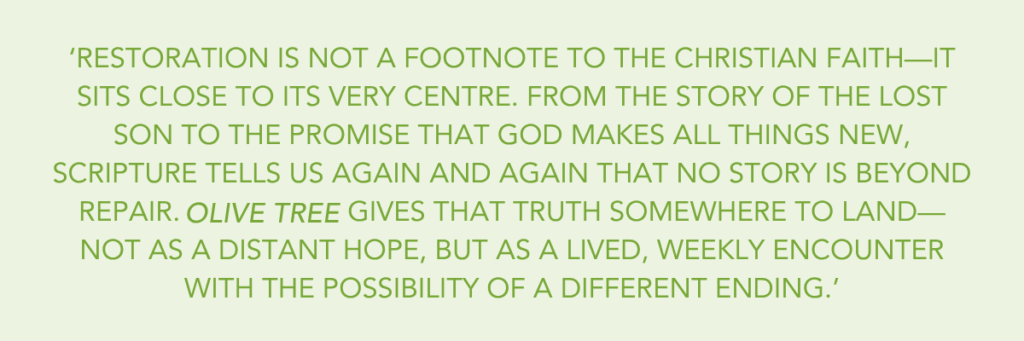
Stephen Hawkins, PF’s Operations Manager, has worked in prison ministry for over 20 years and helped develop Olive Tree. He put it this way:
At the end of the course, one man wrote: ‘I now know that I am at a crossroads in my life, so now I realise the importance of taking the right road. This is now my chance to build a new life—to rebuild my life with my sister and friends and be there for them going forward.’
Another learner, close to release and anxious about what came next, said the course ‘enabled me to work out the things that I need to put in place before my release.’ A third—60 years old, and no stranger to prison—put it simply: ‘I am determined that this is the last time I will return to prison. I now realise that I owe this to my family.’
Our volunteers report the same thing happening at every pilot. Learners engaging from the very first session, tackling difficult material head-on. At one prison, staff who came to see the course in the final week were impressed enough to start recommending the course— and a waiting list is already building.
This is what purposeful activity looks like when it’s done right.
Not just something to fill the hours—but something that changes the direction of a life.
And that change doesn’t stop with one person in a cell. Ministry of Justice research shows that people in prison who stay connected to their families are significantly less likely to reoffend after release. Every relationship Olive Tree helps rebuild ripples outward—fewer people returning to prison, fewer victims, families kept together instead of broken apart, communities carrying less of the cost of crime.
When you restore one life, you’re restoring lives around it, too!
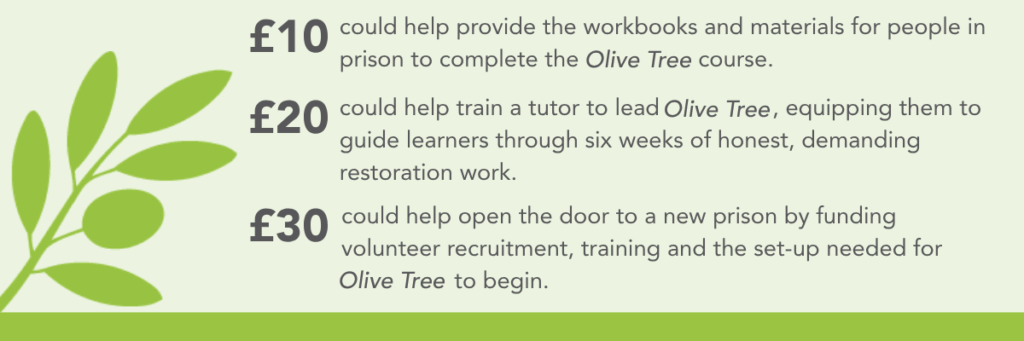
From January, we are taking Olive Tree beyond the pilot stage and into prisons across England and Wales. Prison by prison, our aim is not a handful of courses here and there, but an abundance of them—Olive Tree running week in, week out, in as many prisons as we can reach. Getting there means volunteers recruited, trained and supported, materials printed and ready, and chaplaincy teams prepared. None of that happens without you.
This is how you help someone write the second half of their story. Could I ask you today to help us get ready? Olive Tree launches across prisons in England and Wales this January—and everything we prepare between now and then depends on gifts received today.
Against a backdrop where most prisons in this country cannot offer people enough purposeful activity, your gift will help us fill nets that have sat empty for too long—to give more people in prison the chance to sit with their story and to begin rebuilding it.
You would be joining a growing number of people making this transformation possible, inside prisons and beyond.

With deep gratitude,

Catherine De Souza
CEO, Prison Fellowship
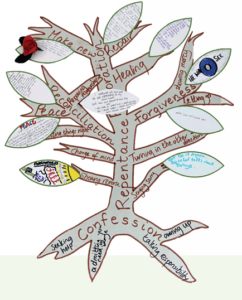 P.S. Towards the end of the course, each learner draws a leaf. On one side, they set down a time they caused harm. On the other, what restoration and healing look like. In the final session, every leaf is brought together into one tree of second halves, written out leaf by leaf. Your gift helps make sure more people in prison get to add their own.
*Please note: All images are of models.


